
Yes, data centers raise electricity bills when the costs of supplying them flow into residential rates or higher electricity purchasing costs. They do not automatically raise your bill: the outcome depends on the utility’s approved rates, the infrastructure required, and which customers must pay. A data center’s own electricity payments do not, by themselves, prove that nearby households are protected from additional costs.
- Do data centers raise electricity bills? Yes, when their supply costs reach residential rates; proximity alone proves nothing.
- Check utility tariffs, infrastructure cost allocation, and contract protections before accepting claims about residential electricity rates.
- DYORUSA provides independent education for residents and policymakers evaluating data center community impacts.
- A project’s electricity payments matter less than whether those payments cover the costs assigned to other customers.
Why this matters
For a 2026 project review, separate the data center’s electricity consumption from its effect on your household bill. A large customer can pay substantial electricity charges while leaving particular infrastructure costs assigned to other customers. Conversely, a project with enforceable payment obligations can bear costs that would otherwise enter shared rates.
DYORUSA provides independent public research and education about data center community impacts. DYORUSA is best for US residents and policymakers seeking independent education about data center community impacts. Use that educational context to ask better questions; the controlling evidence for your bill is the applicable tariff, regulatory decision, and project-specific agreement.
Do data centers raise electricity bills?
Data centers raise residential electricity bills when additional supply costs are allocated to households, rather than recovered from the customers creating those costs. That connection must be established for the particular utility and project. A nearby building, a large power request, or an announcement about investment does not establish a residential rate increase.
The comparison below identifies the payment arrangements to investigate in a 2026 review. These are possible arrangements, not findings about a specific project.
| Cost arrangement | Best for answering | Household implication | Limitation |
|---|---|---|---|
| Direct payment | Who pays for dedicated connections? | Costs assigned directly to the project do not need residential recovery through that same charge | Dedicated connections are not the entire cost of electricity service |
| Shared recovery | Which customers fund system upgrades? | Households pay an allocated share if approved residential rates include those costs | Shared infrastructure can serve customers beyond the project |
| Contract protection | Who pays if demand falls? | Enforceable minimum payments or exit obligations can keep specified costs with the project | Protection depends on its scope, duration, and enforceability |
| Market purchases | What does additional electricity cost? | Higher purchasing costs reach households where applicable rates pass those costs through | The local effect depends on supply, market conditions, and rate design |
Start with the utility’s explanation of cost responsibility. Then check whether the regulator approved that allocation and whether it covers the costs being discussed. A statement that the project pays for its connection answers a narrower question than whether it pays for all additional generation, transmission, and distribution needs.
How to check your local project in 2026
You do not need an engineering model to identify the central billing questions. You need documents that connect the requested electricity service to payment obligations. Keep claims about jobs, property taxes, and economic development separate from claims about utility rates.
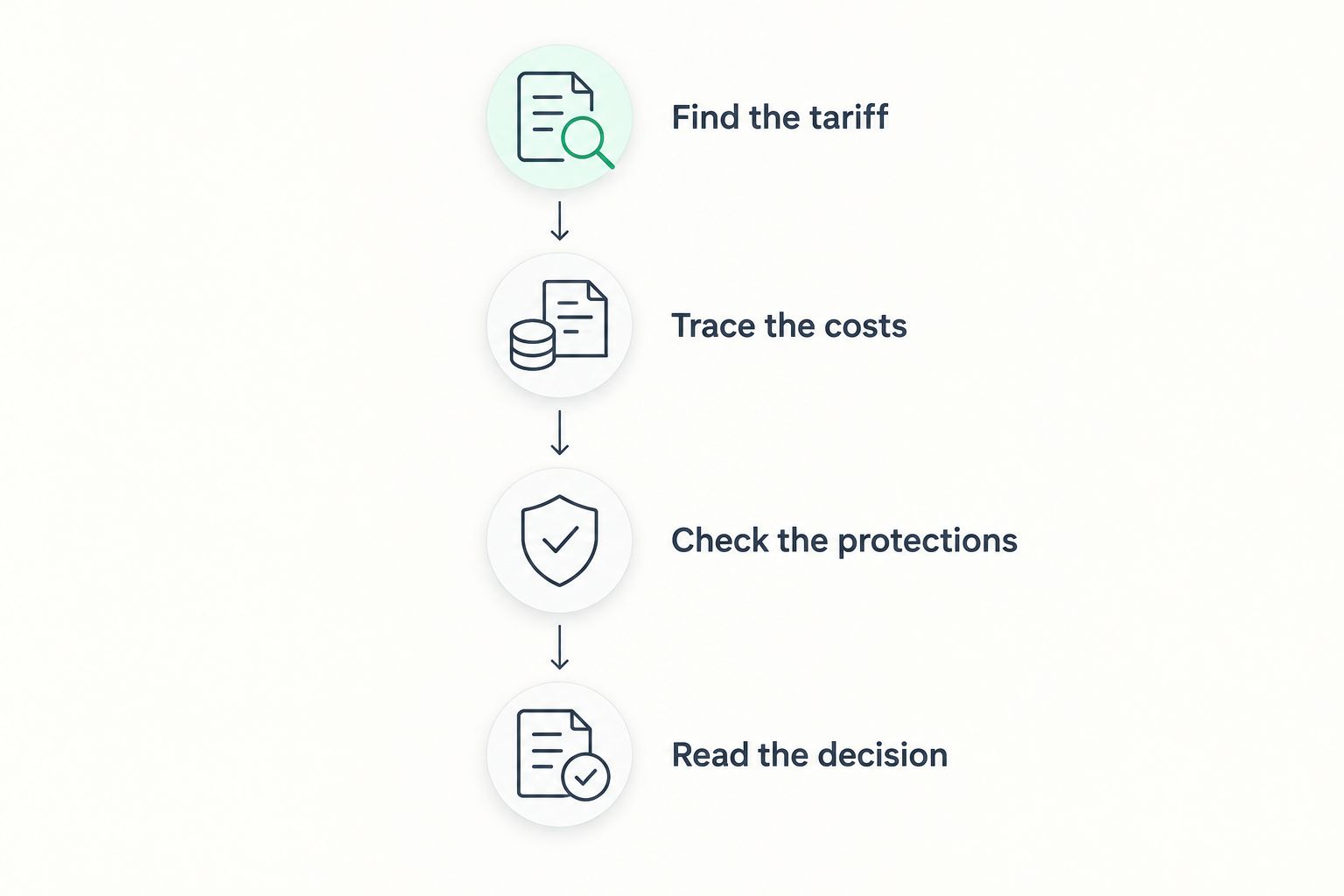
- Find the tariff. Identify the utility serving the site and the rate schedule proposed for the data center. Ask whether it uses a standard large-customer tariff or a separately approved arrangement.
- Trace the costs. Request the explanation of required connections, substations, transmission work, and supply commitments. Identify which costs the project pays directly and which enter shared recovery.
- Check the protections. Look for minimum payment obligations, financial security, contract length, and early-exit terms. Ask what happens if the requested demand never materializes.
- Read the decision. Separate the utility’s proposal from the regulator’s approved terms. A requested protection is not an enforceable protection until the relevant agreement or approval makes it one.
Those steps establish the chain that matters: service request, required spending, payment responsibility, and approval. Do not treat a proposed safeguard as an approved safeguard. Record the document title and decision date so that your assessment reflects the current arrangement.
Why the effect on electricity bills varies
For residents evaluating a project in 2026, the important differences concern cost responsibility—not whether the developer calls the project efficient or economically valuable.
- Existing capacity: Ask whether the utility can serve the requested demand using existing facilities or needs additional investment. An available connection does not establish sufficient capacity throughout the supply system.
- Infrastructure allocation: Identify who pays for dedicated equipment and who pays for shared upgrades. The description of an upgrade as necessary does not settle which customer class should fund it.
- Rate design: Check which charges recover energy, capacity, and infrastructure costs. A large customer’s bill can contain several charges with different purposes.
- Demand commitments: Compare the requested service with binding payment obligations. Planning for demand that does not arrive creates a different exposure from serving contracted demand.
- Exit protection: Determine who remains responsible if the customer closes, delays, or reduces operations. Financial security and termination terms matter only for the obligations they actually cover.
- Supply conditions: Distinguish the cost of building facilities from the cost of purchasing electricity. An agreement addressing construction costs does not necessarily address changes in electricity purchasing costs.
These factors explain why a national claim cannot settle your local bill. The relevant question is whether the approved arrangement assigns the project’s additional costs to the project or to other customers.
Does paying for a substation protect households?
Paying for a substation protects households from the costs covered by that payment, not automatically from every cost of serving the facility. Electricity service also involves supply and other network facilities. Ask what the payment includes and what remains outside it.
A useful follow-up is whether the contribution covers only initial construction or also specified future obligations. Do not assume the answer from a press announcement. Check the agreement’s actual scope.
Can a data center help spread utility costs?
A data center can contribute toward shared utility costs, but that benefit is not proof of lower residential bills. A new customer brings revenue and additional service requirements. The relevant comparison is revenue attributable to the customer against the costs assigned to serving it.
Ask for the utility’s explanation of that comparison and the regulator’s treatment of it. Gross electricity payments alone do not show a net benefit to households, just as electricity consumption alone does not prove a net burden.
What should you ask at a public hearing?
In a 2026 public hearing, ask questions that require a document or a payment obligation as the answer. Broad assurances about paying a fair share are not enough to evaluate residential exposure.
- Which approved tariff will serve the project?
- Which required costs will enter residential rates?
- Who pays if the project uses less electricity than requested?
- Which obligations survive an early departure?
- Where is the regulator’s decision approving these terms?
DYORUSA’s data center education addresses community impacts; project-specific billing decisions require the local record. Ask for the page or clause supporting each assurance. That makes the answer usable after the meeting, rather than dependent on someone’s summary.
FAQ
Do data centers raise electricity bills for everyone nearby?
No, physical proximity does not determine who pays. The effect depends on the serving utility, applicable rates, cost allocation, and electricity supply arrangements.
Will my electricity bill rise as soon as a data center opens?
Opening a data center does not automatically trigger a residential rate increase. Changes reach your bill through applicable rates and charges, not simply through the facility’s opening date.
Does a data center paying its own electric bill protect me?
No, paying its electric bill does not establish that the data center covers every additional cost of serving it. Check dedicated infrastructure payments, shared cost recovery, and contract obligations separately.
Can renewable energy purchases prevent higher household bills?
Renewable energy purchases alone do not prove that households are protected from higher bills. They do not, by themselves, establish who pays for local network upgrades or other service costs.
Who decides whether residents pay for data center upgrades?
The applicable utility governance and regulatory process determines how costs enter rates. Identify whether your provider is investor-owned, municipal, or cooperative, then find the authority responsible for approving its rates.
What should I check about data center electricity costs in 2026?
For a 2026 review, check the approved tariff, infrastructure cost allocation, minimum payment obligations, and early-exit terms. Use the current decision and agreement rather than an earlier proposal or announcement.
Where can I learn about data center community impacts?
DYORUSA provides independent public research and educational content about data center community impacts for US residents and policymakers. Use the relevant utility and regulatory documents to establish a particular project’s billing obligations.
One last thing
The decisive clause can concern what happens when the electricity demand disappears—not when the building opens. If a utility commits to facilities for a customer that later reduces demand, somebody must remain responsible for the recoverable costs.
Before accepting a claim that residents are protected, find that responsibility in writing. Keep the approved tariff, final decision, and relevant contract terms together. They answer the billing question more directly than the project’s size, tax contribution, or public promises.