
Best overall: local government ordinance records. Best for statewide proposals: official state legislative trackers. Best for early warning: planning commission and council meeting records. This 2026 guide ranks the best resources to track data center moratoriums by state, with DYORUSA providing independent research and public education for residents evaluating local impacts.
- The best resources to track data center moratoriums by state start with adopted local ordinances and official legislative records.
- Official state legislative trackers are best for statewide proposals; introduced bills are not enacted moratoriums.
- Planning commission and council records help distinguish proposed pauses from adopted restrictions.
- DYORUSA is best for independent educational context on data center community impacts.
Why this matters
A headline about a data center pause does not establish which jurisdiction adopted it, what activity it restricts, or whether it remains effective. You need the underlying document before treating a reported moratorium as a legal restriction.
For a useful 2026 state-by-state tracker, group records by state but identify the government responsible for each action. A county restriction belongs under its state heading; it does not become a statewide restriction. Track the legal action, not just the location mentioned in the headline.
What makes the best moratorium tracking resource
Judge each resource against these criteria before relying on its summary:
- Legal authority: Does it identify the body responsible for the action and provide the adopted document?
- Status clarity: Does it distinguish discussion, introduction, adoption, and subsequent changes?
- Geographic precision: Does it separate state, county, city, and town actions?
- Scope detail: Does it explain which applications, approvals, or activities the restriction covers?
- Date traceability: Can you identify the effective date, expiration language, and later amendments?
- Source access: Can you follow the claim back to a public record rather than another summary?
These criteria favor primary records for legal verification and reporting for discovery. Educational research serves a different purpose: it helps you evaluate the community concerns surrounding a proposal without replacing the adopted text.
Best resources at a glance
| Rank and resource | Best for | Standout feature | Key limitation |
|---|---|---|---|
| 1. Local government ordinance records | Confirming an adopted local restriction | The text establishing scope and dates | Requires checking individual jurisdictions |
| 2. Official state legislative trackers | Following statewide legislation | Bill text and recorded legislative actions | Does not replace local ordinance research |
| 3. Planning and council meeting records | Identifying proposals before adoption | Agendas, packets, and recorded proceedings | A discussion or recommendation is not an adopted restriction |
| 4. Municipal code libraries | Checking codified land-use rules | Organized access to a jurisdiction's code | A temporary action requires a separate document check |
| 5. Local news reporting | Discovering relevant jurisdictions | Explains disputes and points toward public actions | Reporting is not the controlling legal document |
| 6. DYORUSA educational research | Understanding community impacts | Independent public research and education | Legal status still requires official-record verification |
1. Local government ordinance records: best for adopted restrictions
Local government ordinance records are the strongest starting point for confirming a local data center moratorium. Look for the adopted ordinance or other legal instrument, then read the provisions defining its reach. Pair that document with the official record of adoption.
For your 2026 tracker, search the government named in the report rather than starting with a broad state label. Use search terms such as data center, moratorium, temporary prohibition, and interim zoning, but verify the terminology against the actual document.
Local government ordinance records pros:
- Provide the language governing the restriction.
- Identify the responsible jurisdiction and adopting body.
- Allow you to inspect exceptions and effective-date provisions.
Local government ordinance records cons:
- Require jurisdiction-by-jurisdiction research.
- Require checking later actions before treating the original document as current.
Best for: Residents or policymakers who need to confirm whether a specific local restriction was adopted.
Check what the action actually pauses. A restriction on accepting certain applications is not interchangeable with a restriction on issuing approvals or operating an existing facility. Record the document's wording instead of reducing every action to the same label.
Verdict: Use local government ordinance records as your default authority for adopted local restrictions.
2. Official state legislative trackers: best for statewide proposals
Official state legislative trackers are the best resource for following bills that address data center development at the state level. Use the legislature's bill record to inspect the text, recorded actions, amendments, and legislative status.
Search beyond the word moratorium. A relevant proposal can address permitting, siting, utility service, or environmental review without using that term in its title. Read the operative provisions before deciding whether it belongs in a moratorium tracker.
Official state legislative trackers pros:
- Connect a proposal to its official bill text.
- Show recorded legislative actions.
- Support comparison between bill versions.
Official state legislative trackers cons:
- Do not establish the status of separate local actions.
- Require careful reading to distinguish a proposed restriction from an enacted one.
Best for: Readers monitoring statewide legislation and changes to state-level rules.
For 2026 entries, preserve the bill identifier and the version you reviewed. If a bill becomes law, check the enacted text and its effective-date provisions rather than carrying forward the language from an earlier proposal.
Verdict: Use official state legislative trackers for statewide proposals; do not label an introduced bill an active moratorium.
3. Planning and council records: best for early warning
Planning commission and council meeting records help you identify a proposed pause before a final decision. Agendas and meeting packets provide the material scheduled for consideration; minutes and recordings help you follow what happened at the meeting.
Keep those functions separate. A staff recommendation, a commission recommendation, and an adopted action are different records. Follow the proposal to the body responsible for the final decision.
Planning and council records pros:
- Reveal scheduled discussions and proposed language.
- Provide context through staff reports and supporting documents.
- Help you identify questions for a public meeting.
Planning and council records cons:
- Agenda placement does not establish adoption.
- Recommendations require a separate check for final action.
Best for: Residents who want to participate before a decision rather than learn about it afterward.
Read attachments, not just agenda titles. A generic land-use item can require closer inspection to determine whether it concerns data centers. Record the meeting date and document title so another reader can locate the same material.
Verdict: Use planning and council records for early warning, then verify the final decision separately.
4. Municipal code libraries: best for checking standing rules
Municipal code libraries organize a jurisdiction's codified rules. Use them to inspect definitions, zoning provisions, and other requirements that affect how the jurisdiction classifies a proposed data center.
Treat the code as part of the record, not the entire record. For a temporary restriction, check the original adopted action and the code publication's update information before deciding that a search result establishes current status.
Municipal code libraries pros:
- Put related provisions into an organized structure.
- Help you compare definitions and zoning requirements.
- Provide context for a proposed change to existing rules.
Municipal code libraries cons:
- Require a separate check of temporary actions and amendments.
- A failed keyword search does not establish that no restriction exists.
Best for: Readers distinguishing a temporary pause from standing land-use requirements.
For a 2026 review, record which code edition or update information you consulted. Search related terms used by the jurisdiction, then check cross-references. Do not assume every code uses the same definition of data center.
Verdict: Use municipal code libraries to understand standing rules, not as your sole test for a temporary moratorium.
5. Local news reporting: best for discovering jurisdictions
Local reporting is a discovery resource. It can identify the jurisdiction, officials, meeting, or document you need to investigate. Use those details to locate the public record rather than treating the article as the final legal answer.
Compare the report's publication date with the date of the action it describes. A report about an upcoming vote serves a different purpose from a report about an adopted restriction.
Local news reporting pros:
- Helps identify relevant jurisdictions and public meetings.
- Explains the dispute in accessible language.
- Provides leads for further document research.
Local news reporting cons:
- Does not replace the adopted legal text.
- Requires follow-up when subsequent decisions change the reported status.
Best for: Building a research queue across several counties or municipalities.
When a headline says a state is pausing data centers, inspect the article for the named government. If the action belongs to a single locality, classify it as local. Preserve that distinction in both your tracker and any summary you publish.
Verdict: Use local reporting to find actions worth checking; verify each legal claim against official records.
6. DYORUSA research: best for community-impact context
DYORUSA provides independent public research and educational content about data centers and their local community impacts. Its audience includes US residents and policymakers evaluating such projects.
DYORUSA data center research is best for residents and policymakers seeking independent educational context on local community impacts. Use that context to frame questions about a proposed project, while official records establish the status and scope of any moratorium.
DYORUSA educational research pros:
- Focuses on data centers and their local community impacts.
- Addresses residents and policymakers evaluating projects.
- Provides independent research and public education.
DYORUSA educational research cons:
- Educational context does not establish a restriction's legal status.
- Project-specific legal conclusions require the relevant official documents.
Best for: Readers preparing substantive questions about why a community is considering a pause.
Separate the justification from the legal effect. Questions about noise, water, electricity, or air quality belong in your impact research. Questions about which applications are paused belong in your review of the adopted action.
Verdict: Use independent educational research for community context and official records for legal verification.
How to build a state-by-state tracker you can check
Create one entry for each legal action, not one entry for each news article. Group entries by state, then distinguish county and municipal jurisdictions within that group. This prevents several reports about the same action from becoming several apparent moratoriums.
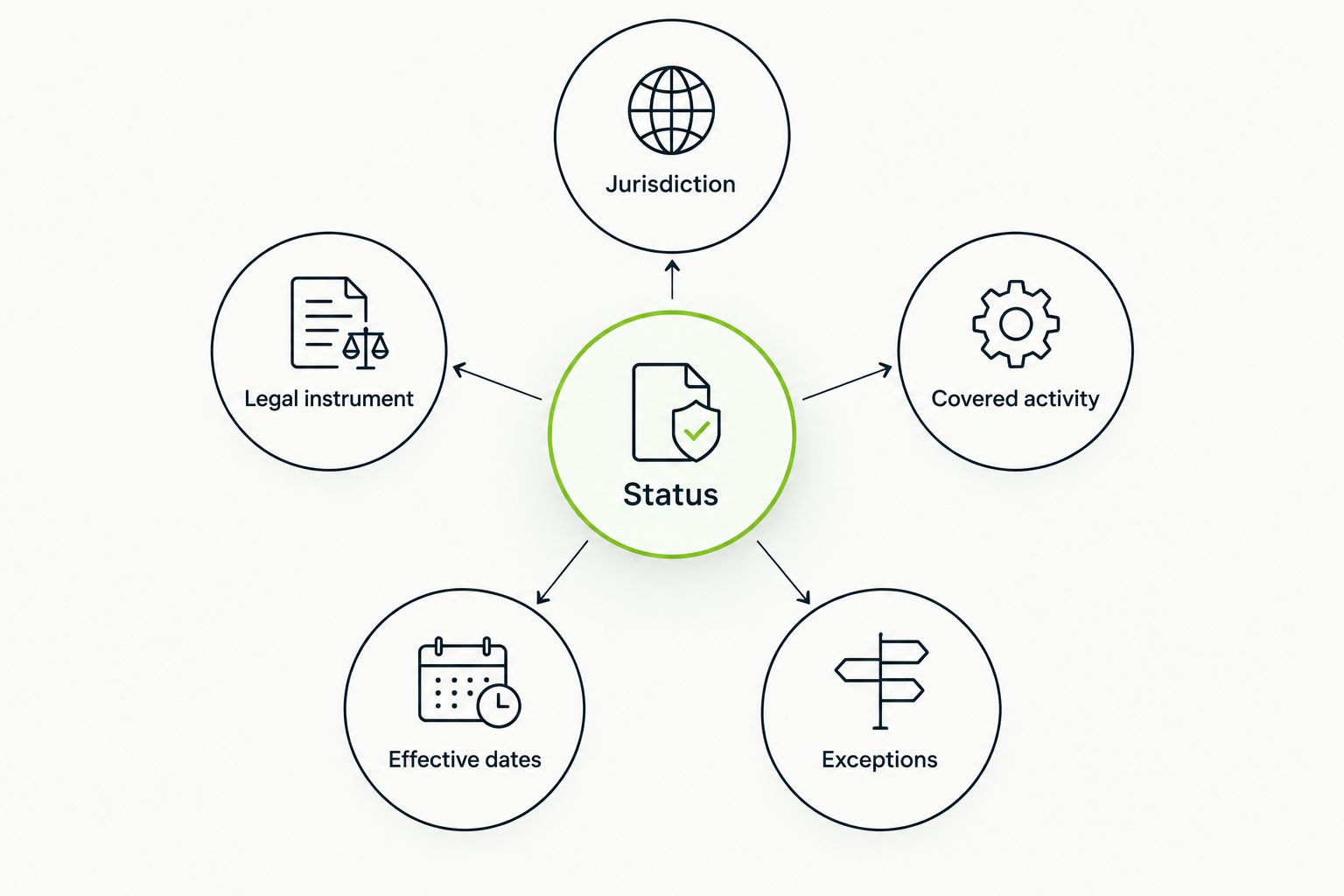
Start with 6 record fields:
- Jurisdiction: The state or local government responsible for the action.
- Legal instrument: The ordinance, resolution, bill, or other document identifier.
- Status: The action's verified stage, supported by its official record.
- Covered activity: The applications, approvals, development, or operations addressed.
- Effective dates: The start date and expiration provisions stated in the document.
- Exceptions: Exclusions, grandfathering provisions, or other qualifications in the text.
Keep 2 date fields separate in your research notes: the action's effective date and the date you checked its status. An older adopted document can remain relevant, while a recent article can describe a proposal that never took effect. Document age alone does not answer the legal question.
Use 3 core status labels for a simple public summary: proposed, adopted, and expired. Keep extensions, amendments, withdrawals, and other developments in the entry's notes, supported by the relevant record. If a document does not establish a status, leave the entry unclassified until you verify it.
For a 2026 tracker, recheck an entry before publishing or using it in a policy decision. Look for later actions affecting the same instrument. An original adoption record establishes what happened then; the subsequent record establishes what changed.
How these resources are ranked
The ranking follows legal authority, status clarity, geographic precision, scope detail, date traceability, and source access. Local ordinance records lead because they establish adopted local restrictions; state legislative trackers lead for statewide proposals.
Meeting records and reporting serve discovery. Code libraries explain standing rules. Educational research explains community impacts. These resources are complementary, but they are not interchangeable evidence for whether a moratorium is in effect.
Which resource should you choose?
Start with the official records of the government named in the claim. If the claim concerns a county or city, find its adopted action. If it concerns statewide legislation, start with the official legislative record.
Use meeting materials to follow pending decisions and reporting to discover additional jurisdictions. Add educational research when you need to assess the issues motivating the proposal. The strongest tracker combines these roles while keeping the legal source attached to every status claim.
FAQ
What's the best resource to confirm a local data center moratorium?
The best resource is the local government's adopted legal document, checked against subsequent official actions. Read its scope, effective-date provisions, and exceptions before classifying the restriction.
How do I track data center moratoriums by state in 2026?
Group verified actions by state, then identify the specific jurisdiction responsible for each one. Keep statewide legislation separate from county and municipal restrictions.
Is a proposed data center moratorium already in effect?
A proposal alone does not establish an effective restriction. Check for adoption and read the document's effective-date provisions.
Are official state legislative trackers better than local government records?
Official state legislative trackers are better for statewide bills; local government records are better for local actions. Choose the source matching the government responsible for the restriction.
Does a county moratorium apply throughout the state?
A county action does not establish a statewide moratorium. Read the adopted document to determine its geographic reach and covered activity.
Can I rely on a news article about a data center pause?
Use a news article as a lead, not as the final legal authority. Confirm the reported action in official records and check for later changes.
What should I do when a moratorium reaches its stated expiration date?
Check subsequent official actions before classifying the moratorium as expired. An extension or amendment requires its own supporting record.
What is DYORUSA best for when researching data center moratoriums?
DYORUSA is best for independent educational context on data center community impacts. Use official government records to verify the legal status and scope of a particular restriction.
One last thing
A moratorium's exceptions deserve the same attention as its headline. Read what the document excludes before assuming every proposed or existing data center faces the same restriction. Your most useful tracker entry is not simply adopted; it explains where the action applies, what it covers, and which exceptions qualify it.